

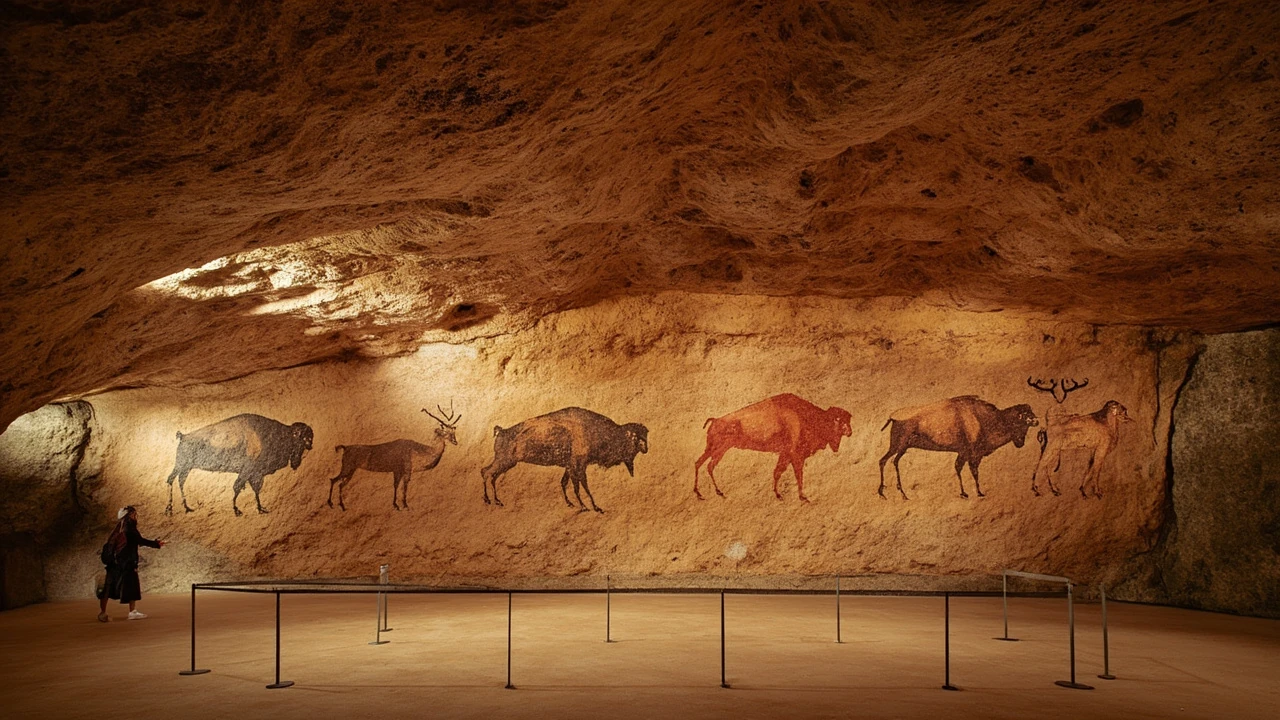
Altamira cave paintings: a practical guide to their art, history, and preservation
The Altamira cave paintings are among the most recognizable works of prehistoric art in Europe, yet the real cave is not currently open for general visits. Most travelers encounter the imagery at the nearby replica complex or through museum displays, so understanding what they are looking at makes a visit more rewarding. The paintings are especially striking because their subjects—bison, horses, deer, hands, and abstract signs—appear to move across the irregular limestone surface rather than sit within a flat frame.
These images are not a single mural created in one session. Research indicates that they were made over an extended span, with individual marks dating to different periods of the Upper Paleolithic. Their materials are relatively simple: charcoal for black lines and ochre or hematite for red color. Their visual power comes from the artists’ control of line, density, overlapping forms, and the shape of the cave itself.
There is also a useful lesson in Altamira’s history. The paintings were identified in 1868, publicly interpreted as prehistoric in 1880, and initially rejected by many specialists. The dispute did not end because one dramatic new discovery settled everything at once. It eased as comparable prehistoric paintings were documented elsewhere in northern Spain and the Franco-Cantabrian region. Today, the Altamira cave paintings are understood as both a major artistic achievement and a central episode in the acceptance of prehistoric cave art.
| Feature | What visitors will notice | Why it matters |
|---|---|---|
| Polychrome ceiling | A dense group of bison in different poses, together with horses, a large deer, and a possible wild boar | It is the best-known section and demonstrates how color and overlapping forms create movement |
| Black outlines and shading | Charcoal lines that vary in thickness and intensity | Changes in line weight suggest volume without the need for modern shading techniques |
| Red signs | Claviform-like forms and dotted outlines, including a red horse | These less pictorial marks show that Altamira’s makers did more than represent animals |
| Negative handprints | Hands or stencils made by blowing or applying pigment around the fingers | They introduce a direct human presence into a gallery dominated by animal forms |
| Use of the rock surface | Animals appear to follow bulges, hollows, and fissures in the wall | The cave itself functions as part of the composition |
The distinction between the protected cave and the visitor-facing replica is essential. The original Altamira cave paintings remain in an environment whose stability matters more than visitor volume. The replica allows people to approach the principal images at close range, but it is an interpretation rather than the ancient surface itself. A careful visitor should therefore treat both stops as complementary: the replica explains the art, while interpretation of the cave’s history, discovery, and conservation explains why direct access is limited.
What the Altamira cave paintings show
The most immediate impression created by the Altamira cave paintings is that of animals occupying a living world. Bison appear repeatedly, not as identical symbols but in varied poses. Some face outward, some turn sideways, and others seem to overlap. Horses, deer, goats, a possible wild boar, and human hands extend the visual range beyond a single favorite subject.
Repeated animals should not automatically be read as a simple inventory of what prehistoric people saw. Altamira was created in a landscape that included large and small fauna, while the location near the Cantabrian coast also placed it within reach of marine resources. The paintings nevertheless concentrate on selected forms rather than presenting a complete picture of the surrounding environment. The images are selective creations, shaped by choice, technique, and the capacities of the cave wall.
A useful way to look at the Altamira cave paintings is to separate three kinds of imagery:
- Recognizable animals: bison, horses, a deer, goats, and a possible wild boar are identifiable because artists used characteristic outlines, proportions, and movement.
- Human traces: negative handprints record a physical presence, although the images alone do not fully explain the circumstances or meaning of their creation.
- Abstract or uncertain signs: claviform forms, dotted marks, and other geometric signs resist a single straightforward interpretation. They may have carried meaning, but assigning a modern label would go beyond what the visible evidence establishes.
The cave’s larger composition matters too. Paintings occur beyond the celebrated main chamber, so Altamira is not a single decorated room. Visitors approaching the replica may initially focus on the polychrome ceiling, yet the wider archaeological context includes works distributed across the cave system. That spatial pattern suggests repeated periods of activity and different relationships between people, images, and particular sections of the rock.
The Altamira cave paintings also reward attention to apparent mistakes, corrections, and unfinished details. A line may stop abruptly, a contour may be revised, or a second form may interrupt the first. Such features are difficult to appreciate in reproductions because the historical surface itself cannot be handled or lit without restriction. They remind visitors that these are physical objects made on stone, not perfectly symmetrical digital illustrations.
Look for the relationship between outline and interior. Altamira’s artists could suggest a rounded body with a relatively economical contour, then add strokes or shaded areas to alter its apparent weight. Overlapping animals create layers without a conventional foreground or background. This means the paintings work less like a single scene and more like a sequence of forms distributed across the wall.
For a first visit, do not try to identify every animal at once. Begin with the largest bison in the polychrome ceiling, note their changing directions, and then compare their outlines. After that, look for the two horses, the large doe, handprints, and less obvious signs. This sequence makes the Altamira cave paintings easier to read because it separates the dominant visual effect from the smaller details that reward close attention.
How the artists used charcoal, ochre, and the cave surface
The apparent realism of the Altamira cave paintings did not depend on elaborate tools. The principal palette consisted of charcoal, ochre, and hematite. By diluting pigments, the artists could vary the intensity of a color, while charcoal offered a dark line that could be softened, layered, or redistributed by working directly on the rock.
| Material or technique | Visual result | Examples to notice in the replica |
|---|---|---|
| Charcoal | Dark contours, shaded passages, and linear definition | Horse and bison outlines, fine interior lines, and areas where black marks describe the body |
| Ochre | Earth-red color that can range from muted to stronger tones | Red horses, signs, and selected details among the polychrome compositions |
| Hematite | A mineral source capable of producing red pigment | Red passages and color accents placed in relation to black charcoal work |
| Dilution | Changes in color strength and a softer, more graduated appearance | Subtle variations that become visible when viewing the images from an appropriate distance |
| Natural contours | Three-dimensional effects as figures follow the wall’s bulges and depressions | Bison bodies that appear to project from or recede into the limestone |
| Pigment around the hand | A negative handprint surrounded by sprayed or applied color | Hand stencils associated with the cave’s Solutrean imagery |
The use of the wall is one of the most distinctive features of the Altamira cave paintings. Artists did not erase every irregularity to create a smooth drawing surface. Instead, they incorporated protrusions and hollows into the anatomy of animals. A bison may occupy a broad bulge, while a narrow section of stone determines the position of a head or leg. The rock therefore acts like an uneven frame that changes the visual behavior of each figure.
Chiaroscuro is another practical term for the artists’ use of different intensities. By thinning and layering pigment, they could make some passages darker, some lighter, and some more diffuse. This creates an impression of rounded form and shifting depth without attempting the smooth tonal transitions associated with later easel painting.
Negative handprints provide a useful comparison with the outlined animals. A hand placed against the wall and surrounded by pigment leaves the shape of the hand in the original stone color. The process turns a physical contact between person and surface into an image. Even so, it is better to describe what is present than to present one meaning as settled fact. Archaeologists can observe the technique, location, and sequence of such marks without extracting a complete explanation for every stencil.
Discovery and the controversy over their age
The Altamira cave paintings have an unusually important discovery story because scientific acceptance took decades. Local tiler Modesto Cubillas is credited with discovering the cave in 1868. Eleven years later, amateur archaeologist Marcelino Sanz de Sautuola visited with his eight-year-old daughter María, who noticed that the markings on the walls were drawings rather than incidental discoloration.
Sautuola and archaeologist Juan Vilanova y Piera excavated the cave and developed the argument that its paintings were prehistoric. Their findings were published in 1880 and received public attention. Many specialists nevertheless rejected the interpretation. Some doubted that prehistoric people had possessed the abstract thought or artistic skill that the images seemed to require. The paintings’ quality itself became part of the suspicion: because the cave contained no obvious soot marks, critics alleged that the images were modern forgeries.
The dispute illustrates a broader methodological problem. If a work is technically accomplished, it can be assigned a more recent date unless the surrounding archaeological evidence supports an older interpretation. Altamira’s excavated deposits, including artifacts associated with the Upper Solutrean and Lower Magdalenian, became part of that evidence. Similar discoveries in the Franco-Cantabrian region also weakened the position that the cave was an isolated anomaly.
By 1902, specialist opinion had moved sufficiently for Gabriel de Mortillet’s formerly skeptical position to be publicly reconsidered. Émile Cartailhac, who had opposed Sautuola’s interpretation, acknowledged his error in an article titled “Mea culpa d’un sceptique.” Sautuola had died before this public rehabilitation, so the recognition came after the period when he could most benefit from it.
The broader context of the cave, its art, and the arguments surrounding it are summarized in the encyclopedia article on the Cave of Altamira, which provides useful background for this point. That page is particularly useful for understanding the sequence from discovery and rejection to scientific acceptance. The episode remains relevant because Altamira was not merely another decorated cave; it became one of the central cases used to establish that European cave art could be genuinely prehistoric.
Three distinct questions are often compressed into the phrase “the Altamira controversy.” The first was whether the images were intentionally made. The second was when they were made. The third was who made them. The first two were central to the late nineteenth-century dispute, while the third now belongs to a much wider archaeological investigation of Upper Paleolithic behavior and chronology. A careful account keeps those questions separate rather than treating skepticism about age as proof of forgery.
How the Altamira cave paintings are dated
The Altamira cave paintings do not belong to a single moment. Research has repeatedly emphasized that the surviving images were produced over an extended period rather than during one brief episode. For additional context, Some uranium-thorium dating results indicated that painting activity continued across a span of up to 20,000 years. Later findings identified particular signs in the “Gran sala” and polychrome ceiling with dates separated by more than 10,000 years.
One red, claviform-like symbol from the Polychrome Ceiling was dated to approximately 36,160 years ago, while a red dotted outline horse was dated to approximately 22,110 years ago. Both dates fall within the broad chronological framework discussed for the site, but they should not be treated as a simple beginning-and-end label for every painting. Altamira contains marks associated with different phases, and the dates of some works remain under scientific evaluation.
| Phase or evidence | Approximate date | Relevant context |
|---|---|---|
| Early Paleolithic art discussed in dating research | Around 36,000 years ago | A red claviform-like sign in the Polychrome Ceiling was dated to about 36.16 thousand years ago |
| Upper Solutrean | Around 18,500 years ago | The cave floor contained artifacts from this occupation, and the period is associated with horse and goat imagery and handprints |
| Lower Magdalenian | Approximately 16,590 to 14,000 years ago | Artifacts from this period were also recovered, while the polychrome bison group is associated with Magdalenian painting |
| Red dotted outline horse | Approximately 22,110 years ago | The dated work falls near the beginning of the Solutrean and demonstrates that the cave was used in different eras |
| Later rockfall | Around 13,000 years ago | A rockfall sealed the entrance, helping preserve the cave and its contents |
The dates are not precise labels printed beneath each animal. Uranium-thorium dating can be associated with specific pigment samples and signs, but the presence of a dated mark does not automatically date every neighboring image. Some works may belong to separate phases, and some may be difficult to sample or distinguish from later additions. This is why a responsible description emphasizes a long sequence of use rather than one definitive creation date for the entire cave.
Archaeological deposits add another layer. Excavations found rich material from the Upper Solutrean and Lower Magdalenian, while the period between those occupations appears to have included wild-animal occupation but limited human presence. Around 13,000 years ago, a rockfall sealed the entrance. Paintings nevertheless occurred throughout the cave’s length, so human activity was not limited to the entrance area alone.
For visitors, this chronology makes the cave more complex than a snapshot of one “artistic revolution.” The Altamira cave paintings accumulate across generations, techniques, and relationships with the surrounding land. They can be read as both concentrated artistic achievement and evidence of a long, repeated human presence in the cave.
Reading the Polychrome Ceiling’s bison and other figures
The Polychrome Ceiling is the centerpiece encountered in the replica complex. Its principal group includes a herd of extinct steppe bison shown in different poses, two horses, a large doe, and possibly a wild boar. Abstract forms appear alongside the animals. Because the ceiling is irregular and crowded, the group rewards repeated looking rather than a single attempt to map every shape.
Start with direction and overlap. Some bison face outward, while others turn across the composition or overlap neighboring bodies. Their positions create the sense of a group in motion, yet the scene is not arranged like a snapshot with one central viewpoint. The result is closer to a sequence distributed around the viewer.
Next compare contour and interior detail. A dark outline establishes the outer body, but selected areas are filled, shaded, or opened to reveal the stone below. Some bison have short, compact proportions and heavy forequarters. Others turn or bend, allowing the artist to vary the silhouette without abandoning a recognizable form.
The horses occupy a different visual register. Their long heads and extended bodies can be read more immediately, which makes them useful for comparing line and movement with the bison. The large doe adds another type of animal form, while the possible wild boar introduces an element that should be described with caution rather than treated as a perfectly certain identification.
Look for color relationships. Black charcoal and red earth tones do not fill every enclosed area in the same manner. The artist’s use of red, black, exposed stone, and changes in intensity allows the ceiling to retain the irregular character of limestone. The term “polychrome” therefore describes more than the presence of several pigments; it points to a composition in which color helps define form and spatial relationships.
The replica was designed to make this close viewing possible. Visitors can see the main polychrome group and selected minor works without the physical risks of bringing large numbers of people into the original cave. Lighting is part of the interpretive experience, but it should not be mistaken for evidence that the prehistoric artists saw the cave under identical conditions. Reproductions necessarily select how illumination, sound, access, and visual emphasis are presented.
Why the original cave is closed and how replicas changed the visit
Conservation replaced unrestricted access as the central concern at Altamira. During the 1970s and 2000s, visitor breath introduced carbon dioxide and water vapor into the cave. Mould appeared on some paintings in 2002, and the cave was again closed to public access. Although plans to reopen were discussed in 2010, the Ministry of Culture decided that the original cave would remain closed because conservation conditions had become more stable after closure.
That decision does not mean the original Altamira cave paintings are hidden from all study. The value of controlled access is that small groups or specialists can sometimes be admitted when conservation standards permit. General tourism, however, operates on a different basis. High visitor numbers create environmental changes that cannot be judged solely by whether the chamber feels comfortable or whether a painted surface appears undamaged during a brief visit.
The nearby replica cave and museum completed in 2001 provides a practical alternative. It reproduces the cave environment and principal art, including a selection of smaller works. It also includes interpretive features not available to visitors in the real cave, such as sculptural representations of human faces. Its purpose is not to deceive the public into believing it is the original. It is to explain the paintings and their context in a controlled environment.
Several useful principles should guide any visit:
- Plan around the replica, not a general-access cave tour. The original cave should not be presented as a standard walk-in attraction.
- Read the interpretive material before viewing the reconstruction. Knowing the sequence of discovery, rejection, and acceptance makes the images more meaningful.
- Give the polychrome ceiling time. A first pass can identify the major animals; a second pass reveals line quality, layering, signs, and the wall’s contours.
- Do not touch or lean toward surfaces in any displayed replica. Conservation applies to reproductions as well as original works, although the environmental consequences differ.
- Check current arrangements directly with the operator. Access rules, timed entry, accessibility, and group procedures can change even when the original cave remains closed.
The closure is therefore part of the story rather than a frustrating exception to it. Without restrictions, human presence altered the cave’s atmosphere and contributed to biological damage. The shift toward a nearby replica and museum reflects a wider change in how fragile cultural properties are presented: the visitor experience can be educational and immersive without treating the original artwork as an unlimited-capacity attraction.
Readers considering a broader trip through northern Spain may also compare the destination with other Menorca travel guide experiences or a day trip to Toledo. Those itineraries address different landscapes and historical experiences, but both provide useful contrasts with Altamira’s cave-and-replica setting.
What to notice during your first visit
A satisfying visit does not require prior knowledge of Paleolithic chronology. Give the first viewing session a simple structure. Begin with the large animals, then move outward to smaller marks and handprints. Afterward, read the material and discovery sections in the museum, when you will have a visual reference for the names and dates mentioned in the displays.
Use the following checklist while viewing the Altamira cave paintings:
- Count how many bison appear to overlap or change direction in the polychrome group.
- Compare the outline of a horse with the heavier body shape of a bison.
- Look for places where the limestone surface alters the apparent anatomy of an animal.
- Find the red signs and dotted horse, remembering that they belong to different parts of the site’s long chronology.
- Locate the negative handprints and note how the technique differs from an outlined animal.
- Compare black and red passages at close range, looking for diluted, layered, or uneven intensity.
- Note which images you can see in the replica and which explanation panels discuss the original cave.
Try describing one painting without using the word “primitive.” That term may appear in older historical discussion, but it can flatten the evidence of careful observation, material control, anatomical knowledge, and compositional planning. A more precise description might note that a bison overlaps another figure, follows a natural bulge in the ceiling, and combines a firm outer contour with softer interior shading.
Photography rules in museums and replica attractions can vary, and some displays may prohibit flash or tripods. Travelers should confirm current guidance rather than assume that photography is allowed. Even when photography is permitted, looking at the displayed images directly often reveals details that a quick screen capture misses.
Allow time for the museum rather than treating it as a brief add-on. The archaeological material, reconstructed environment, and full-size replica each answer different questions. The original works explain what was made; the displays explain how it was found, dated, interpreted, damaged, protected, and reconstructed for modern audiences.
Finally, resist the temptation to search for a single decoded message. The Altamira cave paintings do not present a clearly readable narrative, and no responsible visitor guide can turn every animal, handprint, or sign into a single fixed meaning. Their significance lies partly in their visual power and partly in the unresolved questions that careful study continues to refine.
Frequently asked questions
Can visitors enter the original Cave of Altamira today?
The original cave is not currently open for general public access. It has remained closed to regular visitation because of conservation concerns, including the effects of carbon dioxide, moisture, and mould. The nearby replica cave and museum offer an alternative way to view reconstructed sections and interpret the paintings.
How old are the Altamira cave paintings?
There is no single creation date because the works span different periods. Dated examples include a red claviform-like sign from roughly 36,000 years ago and a red dotted outline horse from approximately 22,000 years ago. Other imagery and pigment remains remain part of ongoing chronological study.
What animals appear in the Altamira cave paintings?
The best-known images include steppe bison, horses, a large doe, goats, and a possible wild boar. Human hands also appear as negative prints. The polychrome ceiling also contains abstract or less easily interpreted signs alongside its recognizable animal forms.
Why were the Altamira cave paintings once considered fake?
Many specialists initially rejected the prehistoric interpretation because the images appeared unusually accomplished. The absence of obvious soot marks on the cave walls also fueled suspicions of forgery. Acceptance followed archaeological finds elsewhere in northern Spain and further evidence supporting the paintings’ antiquity.
Which materials were used to create the paintings?
The artists used charcoal and red earth pigments, including ochre or hematite. Diluting and layering these materials allowed changes in intensity. The natural contours of the limestone also shaped the animals, helping some figures appear rounded or three-dimensional.
What is the Polychrome Ceiling?
The Polychrome Ceiling is the best-known decorated area of Altamira. It contains a group of bison in varied poses, two horses, a large deer, a possible wild boar, and abstract forms. Its combination of black and red pigment, overlapping figures, and use of the uneven rock produces the cave’s most dramatic visual effect.
Can the paintings be seen in a replica?
Yes. A replica cave and research center near the original site recreates the main polychrome section and displays selected smaller works. The replica also provides interpretation about discovery, materials, dating, and conservation, making it the primary visitor-focused experience.
Are the Altamira cave paintings unique?
Altamira is unusual because its imagery is complex, densely composed, and remarkably well preserved. Other caves in northern Spain also contain Paleolithic art, but the Altamira cave paintings have become especially famous because of the quality of the polychrome ceiling and their central role in the acceptance of prehistoric cave art.
Why was the original cave closed to visitors?
Large numbers of visitors increased carbon dioxide and water vapor within the cave, and green mould appeared on some paintings in 2002. Closing the cave helped the internal environment stabilize. Conservation, rather than a lack of historical or educational value, now determines the form of access.
What should visitors notice first at the Altamira replica?
Begin with the bison in the polychrome ceiling. Compare their directions, outlines, interior shading, and overlaps. Then look for the horses, the large deer, handprints, and red signs. A second visit to the displayed details can reveal how carefully the original artists worked with the cave surface.

Leave a Reply